


Please Leave Us A Message
Privacy statement: Your privacy is very important to Us. Our company promises not to disclose your personal information to any external company with out your explicit permission.

Ninghai Baiweixiang Bean Products Co., Ltd.
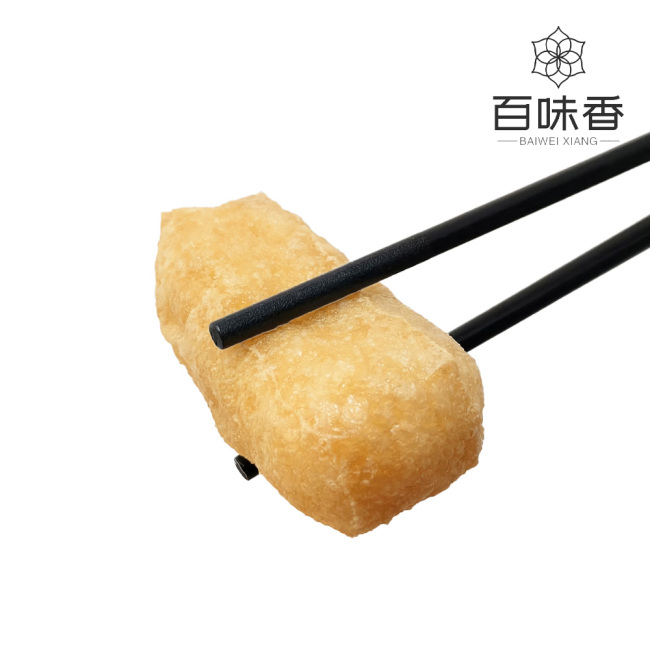
Texture decides the slot: puffs are sponges built to soak, dried tofu is a pressed block built to chew, and tofu skin is a thin sheet built to drape — pick the form by what the dish does to it.
| Form | Moisture | Protein / 100 g | Texture | Storage | Best use |
| Fried tofu puff | 50–68% | 13–17 g | honeycomb sponge, absorbs 2–3× its weight in broth | frozen −18°C, 15–24 months | hot pot, soup, braised dishes |
| Dried tofu (brine) | 52–62% | 16–22 g | firm, elastic chew, holds a clean cut | vacuum, ambient 6–9 months | slicing, skewers, snack packs |
| Tofu skin (yuba / fried brine slice) | 8–15% | 38–45 g | silky, elastic sheet | vacuum, ambient 9–12 months | premium rolls, dim sum, salads |
The forms separate at the coagulation and cutting steps of Soy processing. Yuba is not cut from a block at all — it is the film lifted off the soymilk surface as it heats, which is why its protein runs nearly three times the puff's and its texture is a sheet rather than a cube. The puff and the dried block start as the same slab — the contrast a tofu puff vs dried tofu texture comparison chart draws is one slab, two machines: the fryer makes one a sponge and the press makes the other a chew.
Two spec lines matter more than the rest for tofu skin. First, the tofu skin yuba rehydration ratio specification: dried sheets take up 2.5–3.5 times their weight in warm water at about 40°C over 20–30 minutes, so a 500 g pack yields 1.75–2.25 kg of usable product. Second, thickness: at 1–2 mm the sheet rolls without cracking; above 3 mm it folds like leather and the premium illusion is gone.
For the two block forms, the dried tofu vs tofu skin protein comparison is where category margin hides — but against the puff the maths is simpler: per 100 g, dried tofu carries 16–22 g of protein against the puff's 13–17 g, and it does it without a freezer. That is the whole retail argument in one line: similar price per kilo, more protein, no cold chain.
✅ Bottom line: Puff for absorption, dried tofu for chew and protein, tofu skin for premium sheets — each form owns a different slot.
Split by logistics first and protein economics second. Of everything in a Soyfood range, these three forms differ most in how they travel: dried tofu and tofu skin go ambient, puffs eat freezer volume, and protein-per-dollar decides which form earns the extra cartons.
Protein per dollar is the number a category manager rarely sees on a price list. At typical FOB levels it looks like this:
| Form | FOB per kg | Protein / 100 g | Protein cost per 10 g |
| Dried tofu (brine) | $3.20–3.60 | 16–22 g | $0.16–0.22 |
| Fried tofu puff | $3.20–3.35 | 13–17 g | $0.21–0.26 |
| Tofu skin (dry) | $8.00–12.00 | 38–45 g | $0.21–0.28 |
Read the table honestly: tofu skin costs two to three times more per kilo, yet lands in the same protein-cost band because it is nearly three times denser in protein. You are paying for texture and shelf presence, not for protein — which is the correct reason to buy it, as long as the menu justifies the premium.
The logistics side splits cleanly:
One caution on mixed orders: the three forms fail differently, so do not let one COA template cover them. A puff is judged on cell structure and rebound, dried tofu on moisture band and piece count, tofu skin on sheet integrity and rehydration. Baiweixiang issues a separate spec sheet per form for exactly this reason — a single generic certificate would sign off nothing useful. Custom packaging and private-label terms follow the same per-form discipline.
✅ Bottom line: Ambient forms fill pallet density and protein value; puffs buy absorption and need reefer space — split the container on logistics, price it on protein.
Q: Can tofu skin replace dried tofu in the same dishes?
A: Only where the dish wants a sheet — rolls, salads, dim sum wrappers. In braises and stir-fries the chew of a pressed block is the point, and no rehydrated sheet reproduces it.
Q: Which form has the best protein economics?
A: Per 10 g of protein they all land within $0.16–0.28, so the dried tofu vs tofu skin protein comparison is closer than the price gap suggests. Dried tofu wins slightly on cost, tofu skin wins on the premium price you can charge per dish.
Q: What do I check on a tofu skin sample?
A: Three things: the tofu skin yuba rehydration ratio specification against 1:2.5–3.5, sheet integrity after a 30-minute warm soak, and colour — an even amber beats a blotchy dark surface. Baiweixiang supplies all three numbers per batch, and a tofu puff vs dried tofu texture comparison chart of the same style is available on request for buyers building a category from zero.
Send your shelf plan — frozen, ambient, premium — to Ninghai Baiweixiang Bean products Co., Ltd. and the reply will map each form to a slot: grade sheets per form, protein economics at your volume, and a mixed-container proposal with MOQ per SKU stated up front. Wholesale and OEM buyers new to the category can request a three-form sample box so the texture decision happens in your kitchen, not on a spec sheet. Factory terms are quoted per destination port, with a separate certificate per form attached.
Email:aadaa12345@126.com
Mobile: +86 13867835694
Website:www.nhbaiweixiang.com
Email to this supplier
Privacy statement: Your privacy is very important to Us. Our company promises not to disclose your personal information to any external company with out your explicit permission.
Fill in more information so that we can get in touch with you faster
Privacy statement: Your privacy is very important to Us. Our company promises not to disclose your personal information to any external company with out your explicit permission.