


Please Leave Us A Message
Privacy statement: Your privacy is very important to Us. Our company promises not to disclose your personal information to any external company with out your explicit permission.

Ninghai Baiweixiang Bean Products Co., Ltd.
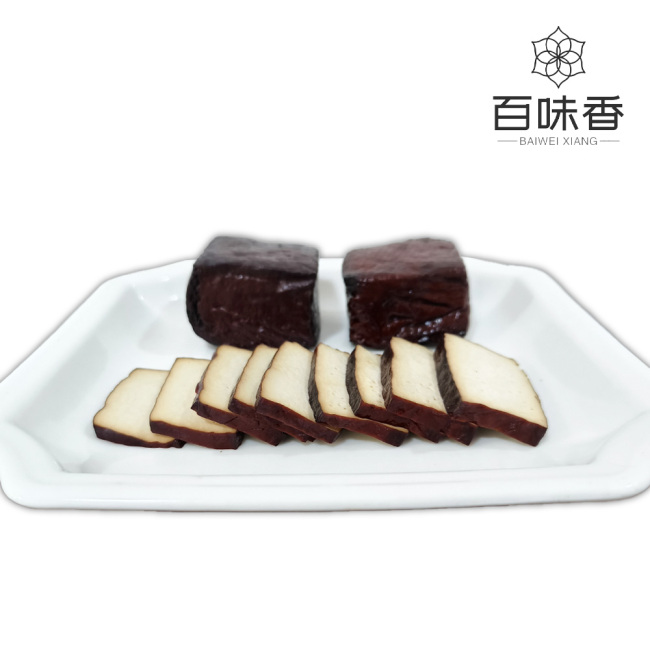
Moisture decides what you are paying freight on and protein decides what you are actually getting: every 3 points of moisture above 60% adds water weight, and protein below 16 g per 100 g almost always means starch filler, not a leaner bean.
Moisture is not set at packing. It is fixed earlier in Soy processing, at the press — how long the slab sits under weight after coagulation determines the water the block will carry through braising, vacuum sealing and three weeks of ocean transit. A factory that cannot hold a moisture band cannot hold a grade, no matter what the label says.
| Moisture band | What it means | Cost effect | Texture risk |
| 52–55% | premium press, longest vacuum life | least water per carton | firm, chewy bite |
| 55–60% | standard export band | balanced | braises clean, slices without crumbling |
| 60–62% | upper limit | freight on water, shorter shelf life | softer bite, weeps in the pack |
| below 50% | over-pressed | looks cheap per kg, expensive per bite | rubbery after cooking |
Protein is the integrity check. Reading the dried tofu moisture content and protein specification together catches what moisture alone hides: a block at 62% moisture and 16 g protein has been stretched with retained water, while 55% and 21 g is a dense, honest press. Across the whole Soyfood shelf, dried tofu carries the highest protein per 100 g of any form, which is exactly why filler shows up here first — it is the easiest number to dilute.
Moisture also drives the fry behaviour of the same base material. Tofu moisture content effect on frying is direct: a wetter curd foams less, absorbs more oil per kilo, and throws water into the fryer, which shortens oil life; a drier curd puffs tighter and fries cleaner. Buyers who take both dried and puffed forms from one factory are effectively buying the same press twice.
Piece count closes the loop. A 500 g pack at 62% moisture holds fewer dry-matter grams than the same pack at 55%, so the number of pieces that survive a service day without breaking falls even when the count on the label matches. Weigh the pieces, not just the pack.
✅ Bottom line: Specify 52–60% moisture and 16 g-plus protein per 100 g in writing; both numbers set your real cost per serving.
Dried tofu too hard after cooking why? Nine times out of ten the cause is moisture: below roughly 50% the block was over-pressed or over-dried, and no amount of simmering puts the water back.
The full fault list behind dried tofu too hard after cooking why, in the order a QA check should rule them out:
None of these need a laboratory to catch. Four checks on a pre-shipment sample cover them:
Put the bands in the contract, not in an email. A purchase order that states 52–60% moisture, minimum 16 g protein per 100 g and a piece count per 500 g — the three numbers that define a pressed Bean curd grade — gives your inspector something to sign against, and gives the factory a fair target. Baiweixiang issues a COA per batch against exactly these lines, because a spec that lives only in correspondence protects nobody.
✅ Bottom line: Hardness after cooking traces to moisture, salt or filler; a 100 g oven test on the sample catches all three before the deposit.
Q: What moisture should I write into the contract?
A: 52–60% for dark brined dried tofu, with 55% as the target midpoint. Below 52% you pay for press time and risk rubberiness; above 60% you pay freight on water and lose vacuum-pack life. If you also take puffed forms from the same line, remember that tofu moisture content effect on frying runs the same direction — a wetter curd means a weaker, oil-hungry puff.
Q: Is higher protein always the better block?
A: Up to a point. Above about 22 g per 100 g the press gets so dense the texture turns leather-like in soups. Match the protein to the application: 18–20 g suits braising and slicing, 20–22 g suits dishes where the block must survive stirring.
Q: Can I verify a shipment without lab equipment?
A: Yes. The 100 g oven test, a kitchen scale and one frozen reference sample are enough to check moisture, and the dried tofu moisture content and protein specification on the COA covers the rest. If a batch fails the squeeze test, reject it on the spot and photograph the test — Baiweixiang replaces failed batches within the claim window without argument.
Send your application — braising, slicing, stuffing or snack format — to Ninghai Baiweixiang Bean products Co., Ltd. and you will receive the grade sheet for that application: moisture band, protein floor, piece count per 500 g and the COA template your inspector will sign. Wholesale and OEM buyers can request a three-grade comparison sample so the moisture decision is made on texture, not on paper. Factory terms are quoted per destination port with certificates attached, and every quote states the moisture band it is priced against.
Email:aadaa12345@126.com
Mobile: +86 13867835694
Website:www.nhbaiweixiang.com
Email to this supplier
Privacy statement: Your privacy is very important to Us. Our company promises not to disclose your personal information to any external company with out your explicit permission.
Fill in more information so that we can get in touch with you faster
Privacy statement: Your privacy is very important to Us. Our company promises not to disclose your personal information to any external company with out your explicit permission.